
How to Get a Spanish Driving Licence in 2026: Exams or Exchange
Quick answer (TL;DR): To get a Spanish driving licence, first check whether your foreign licence can be exchanged (canje) without tests. UK licences and car licences from several DGT-listed countries can usually be exchanged, but US, Canadian and Australian licences cannot. Everyone else must pass the DGT (Dirección General de Tráfico) theory and practical tests after six months of normal residence in Spain.
Quick DGT practice test:
Knowledge diagnostic: DGT
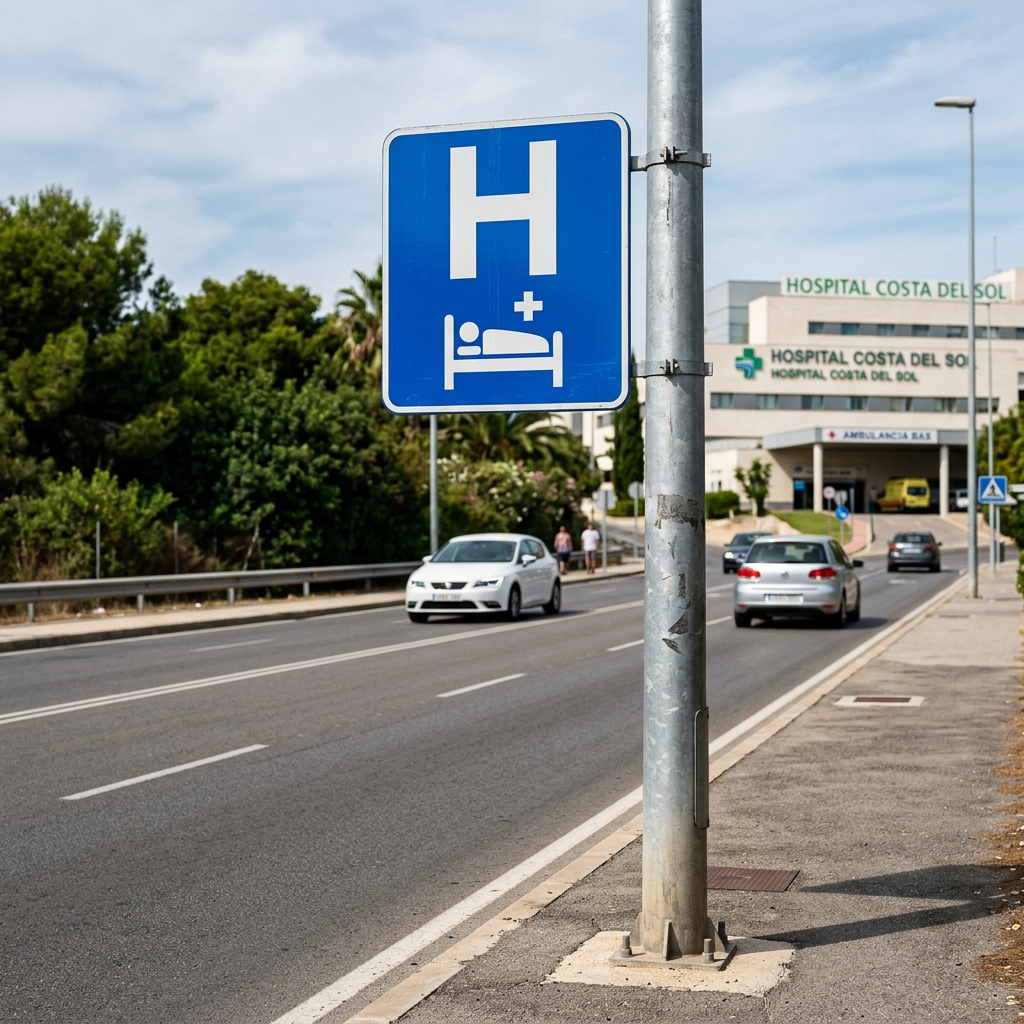
With regard to the Hospital sign, what sanction or infraction can you commit if you do not comply with its indication?
⚡ Updated 2026 DGT Questions · No card needed · 100% Free
How do you get a Spanish driving licence: exchange or exam?
If your foreign licence is on the DGT exchange list, you can usually swap it for a Spanish permit without tests. If your country is not on the list, such as the United States, Canada or Australia, you must pass the theory and practical exams. EU and EEA licences stay valid while they are in force, so they need no exchange.
The table below sets out the main routes to a driving licence in Spain for foreigners, based on the DGT country list dated 26 June 2026. An exchange avoids the theory and practical exams, so it involves fewer appointments and fewer fees. If your country is not on the list, the exam route is your only option, and the exchange table no longer applies to you.
| Your situation | Route | Tests needed? |
|---|---|---|
| UK licence, issued before you became a resident | Exchange (canje) | No |
| Car licence from New Zealand, Japan or South Korea | Exchange (canje) | No, according to the DGT table |
| Licence from Morocco, Algeria, Tunisia or another listed country | Exchange, after the issuing country verifies the licence | No for permit B, according to the DGT |
| EU or EEA licence | Valid while in force | Not applicable |
| US, Canadian, Australian or other unlisted licence | Full exam | Yes, theory and practical |
| Licence obtained after you became a resident | Cannot be exchanged | Yes, full exam |
Sources disagree on whether New Zealand licences need verification before exchange, so confirm with the Jefatura Provincial de Tráfico before you apply. The exchange fee (tasa 2.3) is 28,87 €.
In-person exchanges need a cita previa (appointment). According to the DGT, you can book online or by calling 060, and you can hold only one exchange appointment at a time. Cancelling resets the procedure, and the DGT may ask your home country to verify the licence again. You can check the status of your exchange online with your NIE or NIF. The statuses are PENDIENTE (pending), CONTESTADA (confirmed) and RECHAZADA (rejected). If your application is rejected, ask the Jefatura which documents are missing before you start again.
Do you need to live in Spain before taking the exam?
Yes. Under article 7 of the Reglamento General de Conductores (RGC, Royal Decree 818/2009), a foreigner must prove normal residence in Spain, or study here, for at least six months before sitting the exam. Normal residence means living in Spain for at least 185 days per calendar year, a definition that comes from Directive 2006/126/EC.
Your foreign licence has its own clock. Under article 21 of the RGC, a non-EU licence stops being valid for driving in Spain six months after you acquire normal residence, so you need an exchange or a Spanish permit by then. If you cannot prove residence, the six months count from your regular entry into Spain. The DGT recommends that non-EU visitors carry an international permit before they arrive.
Which medical report do you need, and how long is it valid?
You need a psychophysical fitness report (informe de aptitud psicofísica, also called the certificado psicotécnico) from an authorised Centro de Reconocimiento de Conductores. According to the DGT in 2026, the report expires 90 working days (90 días hábiles) after it is issued, so file your exam application before that date.
Clinics set their own prices. The DGT pages we checked do not list an official fee for the report, so ask the clinic for a quote before booking. Keep the signed report, because you need it with the Mod. 04 application form.
The report is a medical fitness check, not a driving test, so you do not need a driving lesson to get it. If you have a health condition that could affect driving, mention it at the start of the appointment, and ask the centre how it will be recorded. The report is also required with the exam application, so get it before you plan your test dates.
What does the theory test involve, and can you take it in English?
The DGT theory test for permit B (permiso B) has 30 questions, each with three answer options and one correct answer. You have 30 minutes, with extra time when a video question appears, and you may make at most 3 errors. The DGT described the three-option format when it updated the test in 2025.
Yes, you can take it in English. The Mod. 04 application form lists Spanish, the co-official languages, English, French and German as theory-test languages for permit B. Arabic is not offered. Choose your language when you apply, and check the current version of Mod. 04 on sede.dgt.gob.es, because form versions change.
With three options per question, a blind guess is right one time in three, and every wrong answer counts toward the limit of 3 errors. The video question needs particular care: the DGT allows the video to be watched up to three times, and the time is extended when a video question appears. Read every answer option before you choose.
A passed theory test is valid for two years under article 53 of the RGC. If you need an easy-read version (lectura fácil), request it in advance through your driving school or Jefatura, and only at computerised exam centres.
What does the practical test involve?
The practical test checks your driving on open roads and in traffic. For permit B, it must include at least 25 minutes on open roads, according to Annex VI of the RGC. Faults are graded as eliminatory, serious (deficiente) or minor (leve). You fail if you commit any of the following:
- One eliminatory fault, meaning any behaviour that endangers you or other road users.
- Two serious faults, or one serious fault plus five minor faults.
- Ten minor faults.
Many candidates book through a driving school (autoescuela), which handles the paperwork in the DGT app and provides the test vehicle. Taking the test without one (por libre) has its own rules about the car and the companion. We could not confirm the current conditions, so ask your Jefatura Provincial de Tráfico first. Driving schools say the practical test runs in Spanish or a co-official language; we could not confirm this on an official page.
What does it cost to get a Spanish B licence?
The exam fee (tasa 2.1) is 94,05 € and covers two attempts, theory and practical combined. If you fail twice, you must apply again and pay the fee again. The exchange fee (tasa 2.3) is 28,87 € for a car licence exchanged without tests.
- Exam fee (tasa 2.1): 94,05 €, covering two attempts.
- Exchange fee (tasa 2.3): 28,87 €, with no tests.
- Medical report: set by each clinic.
- Driving lessons: set by your driving school, with no official figure.
Older DGT documents show a lower exam fee, so check the current amount on the DGT fee calculator at sede.dgt.gob.es before you pay.
For budgeting, the two state fees above are the official amounts. The medical report, driving lessons and any repeat attempt come on top, and a repeat attempt means a new application and a new fee, so it pays to be well prepared for each test before you book it.
What is the novice period after you pass?
New drivers in Spain generally start with 8 points instead of 12. According to the DGT, a novice reaches 12 points after two years without offences that cost points. Standard drivers start with 12 points and can rise to 14, and then to 15, after three years each without point-losing offences.
Drivers whose licence is under three years old are generally treated as novices. Novice drivers also generally display an L sign (conductor novel) during their first year, according to the RGC definition. Traffic rules change, so check the current text on boe.es before you rely on exact periods.
How do you get a Spanish driving licence step by step?
Once you know your route, the process runs in the same order for most foreign residents. The DGT does not publish fixed waiting times that we could verify, so leave time between each step and plan around your exam date.
- Check whether your licence can be exchanged without tests, using the table above.
- Prove normal residence in Spain of at least six months, or your enrolment as a student.
- Get the psychophysical report from an authorised Centro de Reconocimiento de Conductores, and file your application within 90 working days.
- Pay the tasa 2.1 (94,05 €) and submit the Mod. 04 form with your DNI or NIE, the medical report and the fee receipt. Choose your theory-test language on the form.
- Book a cita previa (appointment) if your Jefatura requires one, or ask your driving school to book it.
- Pass the theory test: 30 questions, with no more than 3 errors.
- Pass the practical test on open roads.
- Collect your provisional permit when you pass your last exam. It is valid in Spain for three months, and the plastic card arrives by post in about 1.5 months.
- Observe the novice rules: 8 starting points and the L sign during your first year.
Results for computer-based theory tests appear the same afternoon from 17:00. Paper and practical results appear the next day from 17:00, and stay visible for 15 days on the DGT site.
Key takeaways
- First check whether your licence can be exchanged: EU/EEA licences are recognised, and countries on the DGT agreement list can exchange (canje).
- A non-EU licence is valid for a maximum of six months after you become a normal resident in Spain.
- To take the tests you need normal residence in Spain, a medical report from a Centro de Reconocimiento de Conductores and tasa 2.1 (94,05 €, two attempts).
- The theory test can be taken in English: 30 questions, 3 options, 30 minutes, maximum 3 errors.
- Practise the theory until you pass mock tests comfortably before booking.
Frequently asked questions
Can I get a Spanish driving licence with a US licence?
Not by exchange. The United States is not on the DGT list of countries with an exchange agreement. Once you have six months of normal residence in Spain, you must pass the theory and practical tests and pay the 94,05 € exam fee (tasa 2.1).
Can I take the driving theory test in English?
Yes. The Mod. 04 application form lists English among the theory-test languages for permit B, alongside Spanish, the co-official languages, French and German. Arabic is not offered, so choose your language when you apply.
How long is the medical report valid?
According to the DGT in 2026, the psychophysical fitness report expires 90 working days after it is issued. Submit your exam application before it expires.
How long does a passed test last?
A passed theory test is valid for two years under article 53 of the RGC. Check the validity period before you book the practical test, so that the two results line up.
Do I need a Spanish licence after six months of residence?
Generally yes. Under article 21 of the RGC, a non-EU foreign licence stops being valid for driving in Spain six months after you acquire normal residence, so you need an exchange or a Spanish permit by then.
How many attempts does the exam fee cover?
The tasa 2.1 fee of 94,05 € covers two attempts, theory and practical combined. After two fails you must apply again and pay the fee again.
How many points do new drivers start with?
According to the DGT, novice drivers start with 8 points and reach 12 after two years without offences that cost points. Standard drivers start with 12 points.
Sources
- Obtener un nuevo permiso de conducir: requisitos, preparación y presentación a examen — DGT
- Canjes de permisos extranjeros — DGT Sede Electrónica
- Países con convenio de canjes — DGT
- Reglamento General de Conductores, Real Decreto 818/2009 — BOE
- Consulta de notas de examen — DGT Sede Electrónica
- Cómo funciona el permiso por puntos — DGT
- Renovación de permiso próximo a caducar (validez del informe psicofísico) — DGT Sede Electrónica
- Cambios en el examen teórico del permiso B — DGT Revista
Rules and fees can change: always confirm with the DGT or your Jefatura Provincial de Tráfico.